Techno Economic Analysis of Solar Powered Water Pumping Systems for Agriculture
Keywords:
Solar-Powered Water Pumping System, Agricultural Irrigation, Techno-Economic Analysis, Life Cycle Cost, Levelized Cost of Water, Diesel-Powered Water Pumping SystemAbstract
For agricultural irrigation, solar photovoltaic (PV) water pumping systems provide an alternative to diesel-powered pumping, especially in rural and off-grid areas where pumping operation may be impacted by fuel prices and electricity availability. The performance of a solar-powered water pumping system (SPWPS) and a diesel-powered water pumping system (DPWPS) for agricultural irrigation is compared in this study's techno-economic analysis. The research takes into account a 25-year project lifetime, an average peak solar hour of 5.2 hours per day, a daily water requirement of 60 m³/day, and a total dynamic head of 45 m. While life cycle cost (LCC), levelized cost of water (LCOW), and simple payback period (PBP) were taken into account in the economic evaluation, technical sizing was carried out based on the necessary hydraulic energy and accessible solar resource. A 3.0 kWp PV array was chosen for the suggested system since the estimated hydraulic energy consumption was 7.36 kWh/day, which led to a necessary PV capacity of 2.83 kWp. The SPWPS produced an LCC of $8,740 and an LCOW of $0.037/m³ during the course of the 25-year analysis period, while the DPWPS produced results of $19,120 and $0.108/m³, respectively. The SPWPS has a simple payback period of 3.54 years. Additionally, a sensitivity analysis revealed that a 20% increase in diesel fuel prices shortened the SPWPS payback period to less than three years and raised the DPWPS LCOW to $0.130/m³. These findings show that, given the study's assumptions, the suggested SPWPS can offer a technically and financially viable substitute for diesel-powered agricultural water pumping for the project's assessed lifetime.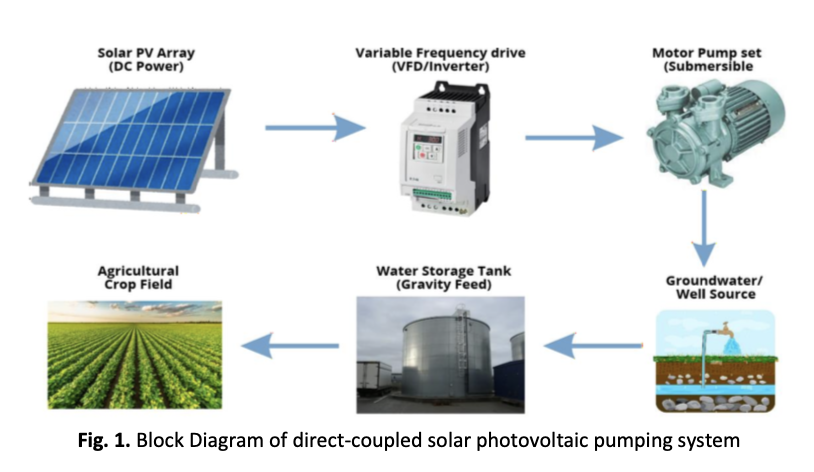
Downloads
Published
2026-11-04
How to Cite
Legison Satria Manik Allo, Thalita Rhea Amelia, Jalalludin Satriya Nayaka, & Nadiya Ayu Astarini. (2026). Techno Economic Analysis of Solar Powered Water Pumping Systems for Agriculture. Sarjana International Journal of Sustainable Food and Agriculture, 7(1), 15–23. Retrieved from https://sarjanaintelek.my/index.php/sijsfa/article/view/24
Issue
Section
Articles