Solar-Powered Edge AI Framework for Real-Time Thrips Population Assessment and Automated Biopesticide Spraying Iin Citrus Orchards
Keywords:
Thrips Infestation, Edge Artificial Intelligence, Tiny Machine Learning, Automated Spraying, Solar-Powered AgricultureAbstract
Thrips (Thrips sp.) are significant pests of citrus plants that can reduce crop yield and fruit quality, particularly under warm and dry environmental conditions. Conventional control using synthetic pesticides can lead to pest resistance, pesticide residues, and adverse effects on non-target organisms, creating a need for more sustainable pest management approaches. This research aims to develop SmartAgroTrips, a solar-powered smart agriculture system that integrates Internet of Things (IoT) technology, on-device Edge Artificial Intelligence (AI), and botanical pesticide spraying for the real-time monitoring and automated control of thrips infestations in citrus orchards. The system was developed using an ESP32 microcontroller, a Light Dependent Resistor (LDR) sensor integrated into a yellow sticky trap, temperature and relative humidity sensors, an ultrasonic sensor, and a battery monitoring sensor. A Tiny Machine Learning classification model was developed to categorize environmental conditions into "Safe" and "Danger" statuses based on light intensity, temperature, and relative humidity. The model was optimized using the EON Compiler and deployed directly onto the ESP32. System performance was evaluated through feature space simulation, hardware-in-the-loop testing, classification metrics, and dynamic actuator validation across various battery voltage conditions. The results demonstrated a clear separation between "Safe" and "Danger" conditions, with the deployed model achieving a weighted F1-score of 1.00 and zero classification errors. The model exhibited an inference latency of 1 ms, peak RAM usage of 1.4 KB, and Flash memory usage of 14.4 KB. A deterministic dual-trigger safety mechanism successfully prevented spraying when the battery voltage fell below the operational threshold, even when the predicted probability of danger reached 1.00. These findings demonstrate that SmartAgroTrips is capable of providing an efficient, autonomous, and energy-saving system for monitoring and controlling thrips infestations, while also supporting the use of eco-friendly botanical pesticides in citrus cultivation .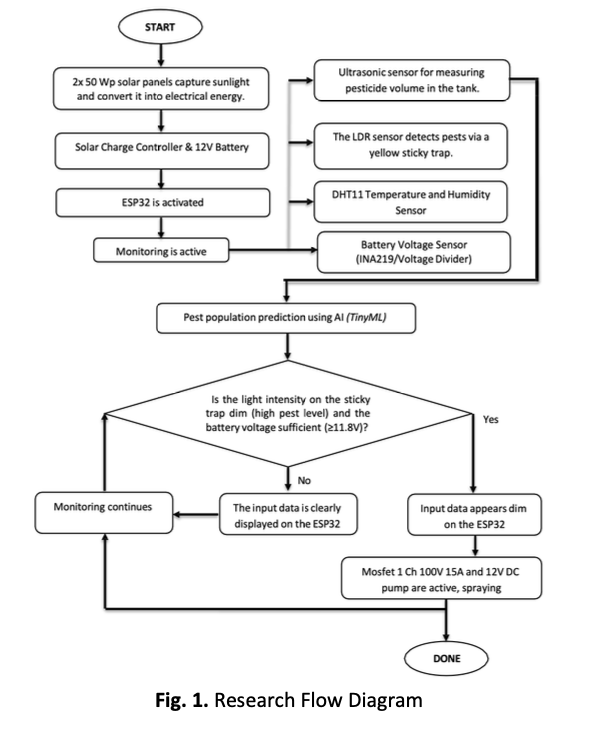
Downloads
Published
2026-11-04
How to Cite
Huda Al Ihsan, Gilang Maulana Lazuardi, Imelda Alya Putri Kusuma, Melanie Putih Dwi Cahyani, Cintiya Diva Ramadan, & Dian Nugraheni. (2026). Solar-Powered Edge AI Framework for Real-Time Thrips Population Assessment and Automated Biopesticide Spraying Iin Citrus Orchards. Sarjana International Journal of Sustainable Food and Agriculture, 7(1), 1–14. Retrieved from https://sarjanaintelek.my/index.php/sijsfa/article/view/7
Issue
Section
Articles